
Springe zum Hauptinhalt

Posts in English

See only blogposts in English

The House on the Hill
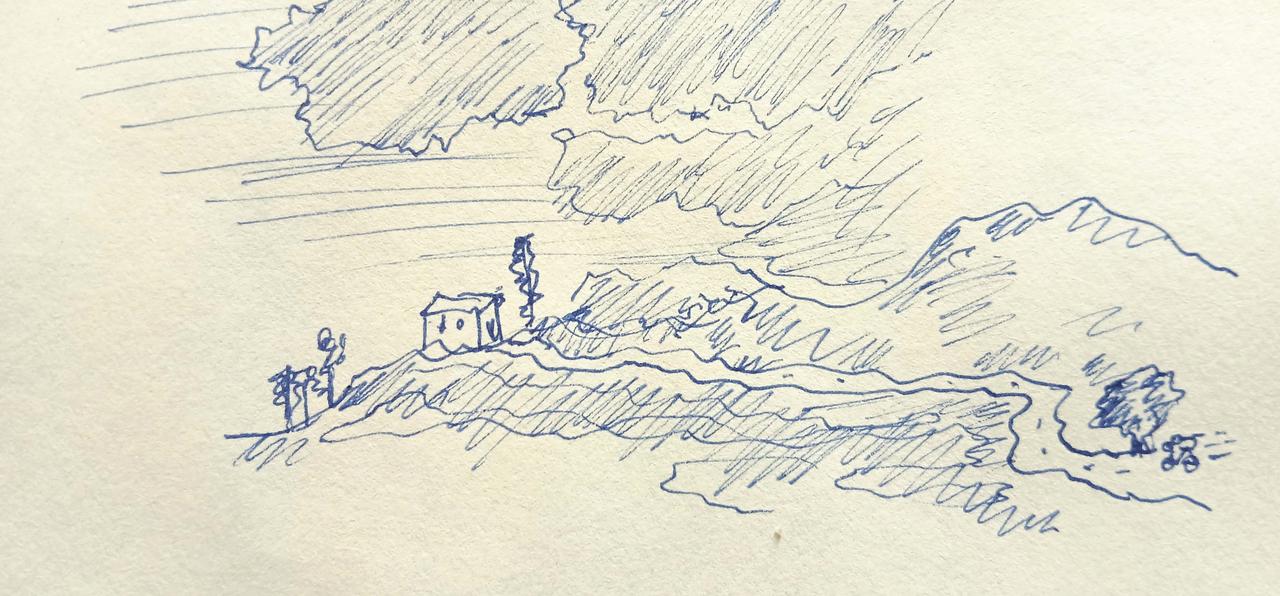
A little doodle of a house next to some trees on a hill

Back when I was becoming a photographer (way, way back in the beginning of time), we had lessons in the history of art. In one of the lessons, the teacher asked us to draw up the ideal house we would want to live in. At the time I was a stubborn and snotty, and I was more interested in travelling than being at home somewhere. So I decided I didn't want to draw a house, ideal or not.

A lot more recently (maybe a few weeks ago) I was doodling something in my sketchbook. Out came this little landscape with the house on the hill. It doesn't say much about the details of the house, or if it is even supposed to be ideal and how... but I can imagine it would really be a very pleasant place to live.

Currently I live in an old house. It is not located as nicely as the one in my doodle, but it is indeed quite nice. And speeking of old times, I mean really old times, even older times than my old photography days: This being an old house, it has it's own history.

During the german occupation, all movement from and to the islands was at times severely limited and controlled, at times completely cut off. Which resulted in people from Athens and other parts of the country being stranded in some place. I can imagine there probably also were internal refugees. And a part of the history of this house I currently live in is that it had become a haven for some of these people.

According to the old family members of the owners, in each of the rooms of the house there lived a family of people. As I enter different rooms in the house, I often think of them. How they lived there, how they felt. The situation with war and occupation must at times have been frightening, but they still must have had days of content to live here, even of joy in their life here. We know that there is at least one person who was born in this house, he came to visit this house some time ago and showed it to his daughter.

Unfortunately nobody recorded the oral history of these people who had lived here for some years. I would have loved to hear or read those stories. I don't know if the house had become an ideal house for them, but I'm sure they were thankful for the house to be there for them.

Picking up Activity

The activity graph on a programming project management tool, kinda looks like a bathroom mosaic, with white tiles and as time passes a bunch of darker colored tiles

Many years ago two of my friends had started a little project for tracking of sports workouts. They had a nice little "proof of concept", which actually worked. Then, for many years, nothing happened and the project was forgotten. Except it still bounced around in my head, while me and my friends were busy with other projects.

The problem with projects like this is that there is some kind of "bit rot", or should we say "dependency rot". The project doesn't only consist of its own code, it depends on a bunch of other code bases, libraries, tools, etc. which invariably change over time. If you are not on the ball with your own project, suddenly it will stop installing or working, because a couple of the underlying libraries have changed. But I digress...

Then, I remembered that project again and started to pester my friend Wu to let us start with it again. The problem was that the code base I had was outdated, while Wu had some newer changes that he needed to apply. Also we needed a place to host the project to work on it. So at the start it was Wu who got busy, installing Forgejo on one of his servers, getting the git project set up, applying and testing his patches.

When that was done I started to dive in. At first with some code reading, some trying out, formulating some lists of tasks. It took me a while to get comfortable, but then it felt so good to be working with my friends again, especially on something that is our own thing and is enjoyable in itself. We called out to a close circle of friends who might join in, and Max jumped right in. With a lot of energy and knowledge.

Now I'm working almost every day a little bit on this. It's a hobby project after all. Programmers recognize the graphic at the top of this post right away: It's the "activity graph" of a project. Each square represents a day (the graph goes back one year, from left to right). Grey squares are where no work was done, Yellowish-reddish squares represent days with work done, the darker the more. So you can clearly see how the work has picked up after a long hiatus. And I'm sure it won't stop there ... "more to come" as they say.

The forgejo site is currently locked and password protected. On the one hand, we want to move the project a little bit more ahead before "presenting it". On the other hand, we're a bit cautious after reading all the stories of AI bots thrashing web sites and especially code repository sites. We don't want to feed the ghouls and we certainly don't want to deal with the bandwidth and server hassles. We will have to find a solution for this.

Ink Clouds

Ink clouds in the water while cleaning a fountain pen

Since moving house in late spring, there are a number of things that I still can't locate. They are either in one of the yet-unpacked boxes, or I've put them somewhere and lost track of them.

For some weeks now, I was looking for my bottle of super-duper document ink for one of my fountain pens. It's a "document" ink, which means it won't fade in the light, it's waterproof on the paper and other such nice attributes. But it's also a bit scary, because clogging up a fountain pen might be fatal. Regular cleaning is advisable.

Now for weeks I was sure I had unpacked this little bottle and placed it somewhere, probably separate from other things, and probably out of the light. I had the image of me placing it somewhere almost in my mind. Except, today when unpacking a few more small boxes, I found it. There seems to have been some cloudy images in my mind.

So it was time to clean the fountain pen, to get it ready to be refilled. One thing I really like about that is the ink clouds you get in the water when you repeatedly pump water in and out of the fountain pen. I tried to snap some pictures, but I would have needed a third hand. From a few not very impressive fotos, this was the best one.

"Abi Daré wins the inaugural Climate fiction prize"

The description of this book definitely sounds quite interesting.

Read the Article at the Guardian

What then, is the point?

On Ruben Schade's blog I came across his text titled What's the point? and this definitely interested me. Because I often ask this question ... mostly in my head. People tend to ask this question rhethorically as a way of saying that they do not see a point in doing something. That happens to me too, I admit. I mean, some people in our village going out with a gun and for one afternoon blasting lead bullets into the olive groves aka "hunting"... what's the point?

But I disgress. I do ask myself sometimes "what then, is the point of this?" in a positive way sometimes. Actually those can be some very productive moments. Asking myself what really is the reason why I do something. Or even asking myself what (I think) is really the reason why somebody else does whatever they do.

In Ruben's case, it lead to an interesting blog post about some of the things that interest him, and what is behind it. What a good question, really.

Found a typo in my blog, and then ...

Today I remembered this little weblog again, and as I was looking through the pages, I noticed a typo. Easy fix, I know where the posts are on my laptop, so I can fix the mistake in maybe 10 seconds locally.

But then I have to convince nikola (the static site generator) to re-build the site, so I can upload the fix. Since I haven't touched anything in a while, this might be broken... and it was.

First I had to update / upgrade the virtualenv (in Python 3 this is called a "venv" now). The magic incantation is something like this:

python3 -m venv --upgrade <path_to_dir>

(Where python3 is the python interpreter that should run the whole circus afterwards.)

Next I had to pip install --upgrade nikola, the same for pip itself, then it wanted to have jinja2 installed in the virtualenv (no idea why it wasn't)... and then it worked. Not too bad, all in all. It leaves me enough time to go for a walk before the sun goes down now.

"Here is your cross
Your nails, and your hill"

—Leonard Cohen (Here it is)

So by now I have a simple Ada package that encrypts / decrypts in Playfair and builds an encryption table given a "secret" keyword.

This is still very much beginner code, the suckage is high.

But I had LOADS of fun and learned a lot. The strong typing system is at times infuriating, and at times bordering on beautiful.

Reading lately so much about retrocomputing made me want to get back to some simple coding, like back in the times where figuring out a 30 line BASIC program was an achievement. So a week ago I downloaded a free Ada introduction book and started to "work" through it.

Yesterday morning I finished with it and set me a little challenge: Started to implement Playfair with only the wikipedia article as a base. Despite having guests for lunch AND dinner, at night at 1AM I had a basic POC together that encrypted the example message correctly.